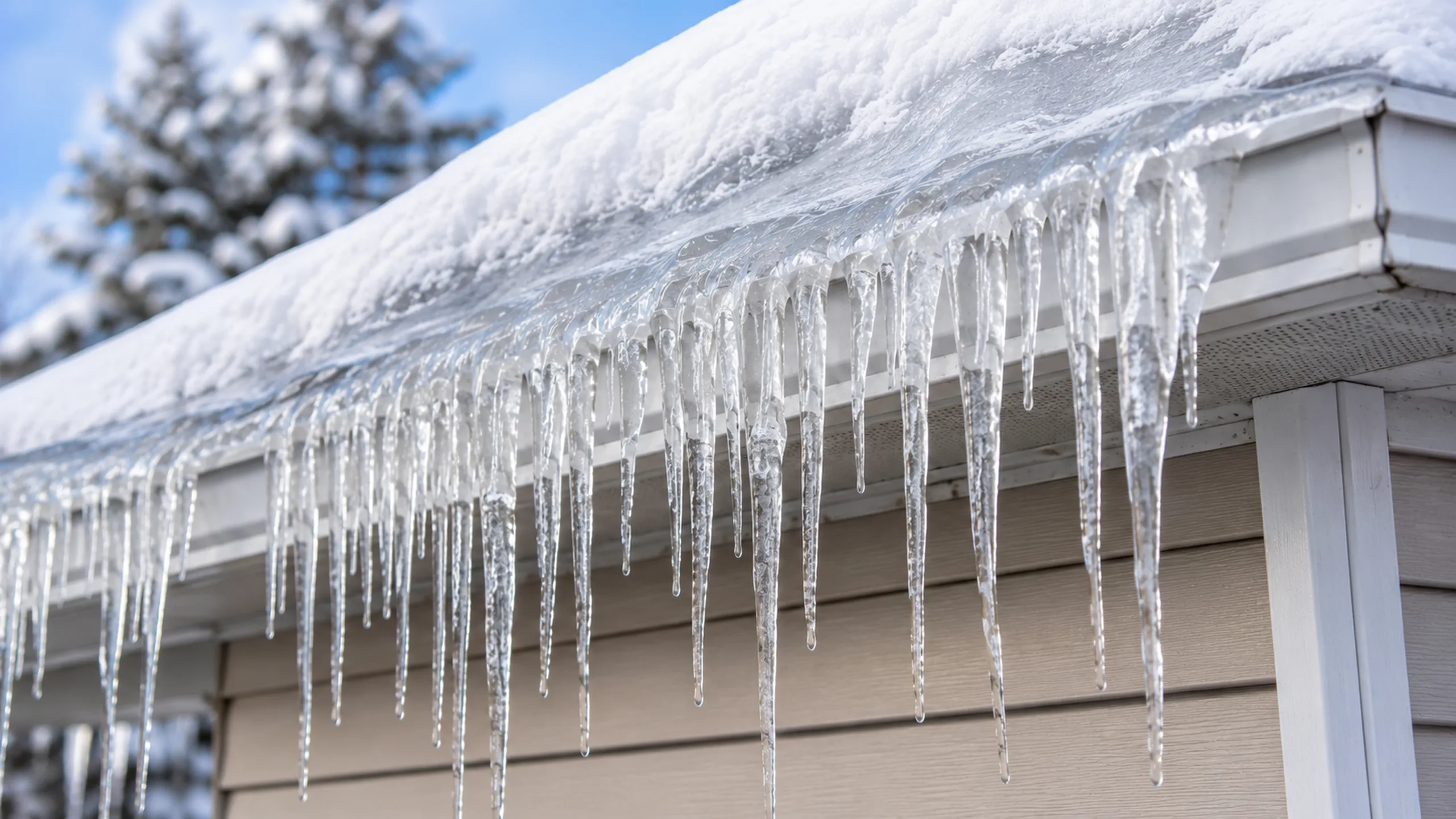
Defect Library · Roseville, MNIce Dam Formation on 1960s Roseville Ranches
An ice dam is a ridge of ice that forms at the eave when warm attic air melts roof snow that then re-freezes at the cold overhang. Backed-up melt water can wick under shingles and into the structure.
What is Ice Dam Formation?
An ice dam is a ridge of ice that forms at the eave when warm attic air melts roof snow that then re-freezes at the cold overhang. Backed-up melt water can wick under shingles and into the structure.
What do we find on Roseville inspections?
Roseville's 1960s ranches have low-slope eaves and were originally insulated to R-19. Today they typically test R-25 to R-35, well below current standard. We map the attic R-value and ventilation imbalance.
History and background
Ice dams are a chronic problem on low-slope, poorly-insulated mid-century homes in cold climates. The mechanism is well-understood and the fix is well-established — but most homes that have ice dams have them because the original insulation R-value never matched current standards and the retrofit additions (often blown-in over the original) didn't address the air-sealing or ventilation half of the equation.
How and why it fails
Warm attic air (escaping through unsealed top plates, can lights, and exhaust fans) heats the underside of the roof deck. Snow on the upper roof melts. Meltwater runs to the cold eave overhang, refreezes, builds a dam, and pushes back under shingles. Eventually water reaches the deck, the insulation, and the ceiling drywall below.
What we look for on the inspection
- Visible icicles and ice ridge at eaves in February
- Interior water staining at the corner of exterior walls upstairs
- Attic insulation depth below R-49 (current MN code minimum)
- Inadequate or missing soffit ventilation
- Recessed lights without IC-rated air-tight housings
Repair cost breakdown
| Repair scope | Cost range | Notes |
|---|---|---|
| Air-sealing only | $800–$1,800 | Foam-seal top plates, can lights, mechanical chases. Largest impact per dollar. |
| Add blown-in insulation | $1,200–$2,500 | Bring R-value to current R-49 standard. |
| Ventilation balance | $800–$1,500 | Add soffit vents, ridge vent, or both. |
| Heated eave cable retrofit | $600–$1,500 | Symptom-only fix. Doesn't address cause. Last resort. |
Code and regulatory references
MN Energy Code requires R-49 in attics. The Minnesota Department of Commerce publishes attic insulation guidance specific to ice-dam-prone homes.
What should you do about it?
Air-seal top plates, add R-49 cellulose, balance soffit/ridge ventilation. Heated eave cables are a band-aid, not a fix.
How this connects to other Roseville defects
Era-defects rarely show up in isolation. A 1965 Roseville rambler that has one of these almost always has two or three more from the same construction window. Our defect library documents the full set we look for, and the inspection report cross-references findings so you can see the pattern.
Related defects in the same era window
Get this checked on your Roseville inspection
Call (651) 666-5602 or request an inspection quote. Ice Dam Formation is included in every standard home inspection we perform. Same-week digital report with photos and prioritized repair recommendations.
Ready for a Roseville Home Inspection?
Same-week reports. Thermal imaging included. Era-specific findings for 1955–1975 ramblers, lakefront walkouts, and new-construction townhomes.